church, Faith, Kingdom of God, Vulnerability

A Church Called Revolution (Part 4 of 4)

A grayscale photo of a young girl sitting on a wooden chair in the balcony of a church, peering over the edge to watch the Easter worship service below. The church has stained glass windows and wooden pews.
Easter Sunday, April 1, 2018

For everyone who has been a part of the Revolution community, whether it was for a few months or for decades, I am so very grateful for you.

I have been thinking a lot this week about all the people who had already planted and shaped Revolution before my family ever arrived, some of whose names I know but I’ve never met.

And I’ve been thinking a lot about Westport United Methodist Church, out of and into whom Revolution was born. The many contributions by its generations of members remind me that the story of this faith community lives on.

All of us, across nearly two centuries, in our own imperfect, flawed ways, did our best to show up for our community, to seek God in all the places that God can be found, and to love our neighbor as ourselves. Nobody could have asked more than that.

I hope that wherever your path leads you next, you find people and places and rhythms that bring you healing, help you love your neighbor, spark your creative imagination, and provide you with deep, soul-restoring rest.

I hope you know that I am cheering you on and rooting for you to be able to bring the best of Revolution—the people and inclusivity and curiosity—forward with you. I hope that the hard parts of Revolution’s journey help you to grow in empathy and strengthen your ability to advocate for yourself and others.

I hope that we see each other soon and often. But even if we don’t, I hope you know I’ll always be happy to reconnect with you, even if it’s been months or years. I’ll never think it’s weird or that it’s been too long. I want to hear about your new church, your new job, and the new book you are reading. I would be equally honored to be trusted with your prayer requests and to be trusted with your questions and doubts.

I hope that you know that you are made in the Image of God, and that you are enough, just as you are. More than anything I hope that you know that you are so very, very loved.

church, Faith, Kingdom of God, Vulnerability

A Church Called Revolution (Part 3 of 4)

A portion of a stained glass window featuring a yellow, orange, and pink torch on top of a pink circle with blue dots. The window also features blue, green, and yellow blocks and a thin red rectangular border.
A Stained Glass Window in the historic building of Revolution Church (Westport UMC) in Kansas City, MO

The fact that something ends (a church, a relationship, a business, a life) is never an indication that what once existed wasn’t beautiful and valuable.

Like my husband acknowledged in his prayer yesterday, we know that due to our collective humanity it’s not possible for a church community to always be at its best. As in every community, there were mistakes and harm, misunderstandings and disappointments, and plenty of pride and short-sightedness to go around. But in those moments when Revolution *was* at its best we cultivated a lot that was life-giving, authentic, and good.

We fed hungry people and invited them into community with us. We gave families in need clean diapers and clothing for their children. We danced and bowled and ate and drank to raise money to meet needs in our city and around the world. We served communion at Pride booths and hosted wedding showers for 🏳️‍🌈 friends.

We delivered meals, visited hospital rooms, attended funerals, and mourned losses of all kinds. We celebrated milestone birthdays, weddings, births, adoptions, transitions, and all varieties of new adventures. We gathered for book discussions, game nights, play dates, chili suppers, fish fries, pancake dinners, Easter egg hunts, and fall festivals. We invited children to wonder about God and the Bible with their full imaginations and all of their questions.

We met together to study the Bible, explore what it means to love God and love our neighbors. We learned from, and learned alongside, others who had life experiences and viewpoints that were vastly different from our own as we talked about our hopes, passions, questions, and doubts.

We valued the holy words that are “I don’t think I believe this” and “I don’t know.”

It was beautiful and life-giving and always, always hard.

There was never an abundance of money or staff. Having a small congregation meant the same people were tapped to do the work again and again and again. Our values and priorities sometimes conflicted with our denomination and the results were usually messy and painful.

It wasn’t hard because we were doing it wrong. It was hard because it was hard

church, Faith, Kingdom of God, Vulnerability

A Church Called Revolution (Part 2 of 4)

Revolution is far from the only congregation that has closed its doors in recent years. Church attendance in the U.S. continues to decline and, rightly, that has spurred on a lot of soul searching about what it all means.

I’ve heard a lot of thoughtful, nuanced, discussions on this topic. Conversations that take seriously the very real harm that religious institutions have caused for centuries. Conversations that honor the journeys of people who are connecting with God in alternative and beautiful ways outside of religious services. I’ve also heard a lot of pretty bad takes.

The point of view that probably upsets me the most, however, is when I hear religious leaders talk about how people just don’t care about spiritual things anymore, about how churches are closing or shrinking because people have become too self-centered, too busy, and too apathetic. That’s never been my experience at any church I’ve been a part of. It was certainly never my experience at Revolution.

I’ve never seen a group of people work harder to build and sustain a faith community than I did at Revolution. I’ve never seen a group of people fight harder to keep alive a vision of what a church could be , even when the odds were stacked against it, than I did at Revolution.

The Revolution community made the difficult decision to close its doors permanently for a lot of complicated reasons, and a few very simple ones, but it was never for a lack of effort, commitment, sincerity, or faith.

Sustaining a small community of millennials and gen x-ers in a historical church in need of big, expensive repairs, in a denomination that was often as inscrutable to our congregation as we were to it, was always going to be an uphill battle. But that doesn’t mean it wasn’t worth the climb

church, Faith, Kingdom of God, Vulnerability

A Church Called Revolution (Part 1 of 4)

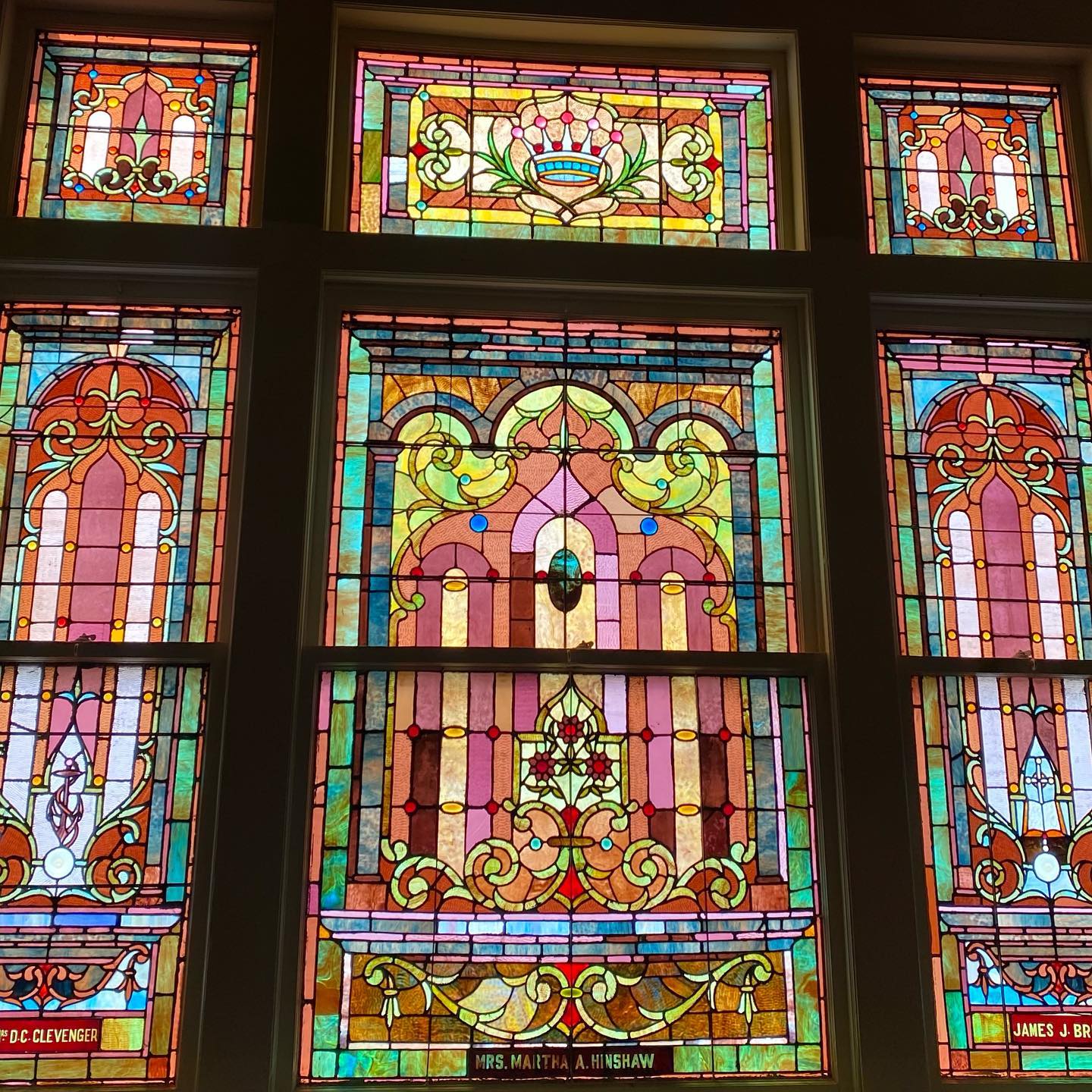
A photo of a wall of rectangular stained glass windows. They are primarily pink, blue, yellow, green, orange, and red.
Stained glass windows in Revolution Church (Westport UMC) in Kansas City, MO

I was annoyed when Scott answered the ad on Craigslist for a part-time worship leader position at a church in midtown Kansas City. I swear it had only been 5 minutes since his last ministry job had ended (somewhat poorly) and didn’t he just want to take a break from working at a church for a little while?

Also, I was already on staff at another church in midtown that I truly loved, and couldn’t we maybe just go to ONE church at a time for a while?

Apparently, we could not.

Scott started working at Revolution United Methodist Church on Palm Sunday of 2010. A few years later I joined him on staff because, despite myself, I’d fallen in love with this quirky, maybe-too-laid-back, inclusive, justice-oriented faith community.

I was won over by this beautiful little church filled with people who didn’t quite know how to church, didn’t really trust churches (for lots of good reasons), but still thought maybe a church where you could practice loving God and loving your neighbor as your full, complicated, beautiful self, was worth the risk.

Today, 11 years and 2 weeks after Scott’s first Sunday at Revolution, the church held its final service and closed its doors.

I don’t know if you’ve ever been a part of a church that has closed, but it’s pretty awful. Watching a church community that you love suffer repeated traumas, and then finally close, is filled with very real grief and pain. Grief for a beloved community that will never meet in this place, in this way, again. Grief for dreams that were unrealized or cut short.

Yes, the Church is universal. Yes, the God of Love is never contained in one building or community or time.And yet the loss is real, and the grief endures.

Because we can’t actually experience the Church universally. We can’t actually experience Love throughout time and space. As humans we can only experience these things in particular places at particular times. I am forever thankful that one of those places that I experienced love, and grace, and community was at a church called Revolution.

Book Review, books, Recommendations, Vulnerability

Book Review: Becoming by Michelle Obama

⭐️⭐️⭐️⭐️⭐️

Becoming by Michelle Obama will likely be one of my favorite books of 2019. I will readily confess that I was already a big Michelle Obama fan, but this memoir made me appreciate her strength, resolve, kindness, and intelligence even more.

The first two sections of this memoir are beautifully written. The stories of her childhood, friendships, education, career, early relationship with Barack, and journey into marriage and parenthood pulled me along in the same way that my favorite novels submerses me in the characters and places that are described.

I instantly cared deeply about not just Michelle, but also about her family, friends, and community as well. No one was presented as a saint, but nearly every person was depicted in a grace-filled, multifaceted way that made me feel like I knew, or at least knew people that were like, these people I’ve never met.

Michelle Obama owns her story, doesn’t shy away from her own strengths and giftings, but consistently and gracefully gives others credit where credit is due. Her writing is smart, funny, and reflective. I smiled and cheered her on, but also teared up at her deep losses along the way.

The farther into Becoming that I read, however, the more my reading pace began to slow. This memoir is well-written, compelling, and enjoyable to read, and yet I found myself taking my time to read in a way that is unusual for me. Normally a book of this size, that holds my interest (which this did), would take me just a few days to finish, but I read this book slowly, portioning it out in small doses over several weeks.

I didn’t rush through this book, mostly, I think, because I was savoring it, but partly because the closer her story came to catching up with present day the more emotional the experience felt.

In the final section of the book, her recounting of the presidential campaign and life in the White House, I thoroughly delighted in her stories of meeting world leaders like Queen Elizabeth and Nelson Mandela, and soaked in her descriptions (both positive and negative) of what it was like to actually live in the White House. It was her personal recounting of the large and small stories that flowed through the news cycle of the past decade that brought my personal emotions rushing to the forefront, however. She and I had much different access and vantage points to these events (for starters, zero percent of these news stories were about me or my family), but I still had my own deeply personal emotions and memories attached to each, and they frequently came rushing to the surface in ways that I hadn’t expected when I first began reading this memoir.

I’ve read other reviews that said they felt Michelle became significantly more guarded in the final section of the book, where she writes about her life in the midst of the presidential campaigns and in the White House than in the earlier two sections. I agree with this assessment, but I don’t blame her. I wonder if she received the same advice that I often have, to only write (or speak) from your scars, not from your open wounds. There are certainly places where I think speaking completely candidly from your current wounds IS called for, but a sure-to-be best-selling memoir probably isn’t one of them.

I know I had to give myself a reality check often through the final chapters of Becoming, reminding myself that the events she is describing just happened in the past few years, even though they seem like a lifetime ago. Of course, I have no idea what on-going points of pain from the past few years Michelle Obama might be reckoning with, but I know she’s not the only one whose wounds from the trauma of current events don’t yet feel anything like scars.

Maybe down the road she’ll write another memoir with more details and unguarded opinions and personal reflections about her time in the White House and transitioning to life afterward. I would happily read it. For now, I’m happy to watch for glances of her in the media as she works to make a positive difference in our country and in our world, “going high” while it seems like so many others are continually finding new and horrifyingly inventive ways to “go low.”

Her final few paragraphs of this book are a gem: honest, hopeful, and encouraging–a sermon I didn’t know I desperately needed. I am so thankful for strong women like Michelle Obama, and so grateful for this beautiful book.

Faith, Gospel, Kingdom of God, Sermons, Vulnerability

Ordinary But Remarkable Things

As an associate pastor, I usually preach at my church only about 4 or 5 times a year. This Sunday was one of those days. I always take preaching seriously, but after the world events of this past week, I felt the weight of the task of preaching even more than usual. What do you say at a time like this? Was I even the right voice to be speaking at such a moment? I confessed to the congregation that I experienced many moments of self doubt this week. Maybe on a day like today the church needed to hear with someone with more experience as a preacher, someone more polished. Perhaps they needed to hear from someone older, someone wiser, someone who was less emotionally raw right now. 

But when I quieted these voices of doubt, I realized, of course, there was no one else for this task. There are other, better, more-experienced preachers than me in the world, but none of these preachers had been called to preach at this place in this moment in time. For better or for worse, this was my work to do today. 

So I made a deal with the congregation. I would push through my doubts and insecurities, and do the work God had called me to do this week, if they would also do theirs. I don’t know what their work is this week, maybe there is a conversation they need to have, a phone call to make, a gift to give,  a neighbor to serve, or a stranger to reach out to. But I know everyone has something they know is the next right thing for them to do, but they haven’t it yet done. They are afraid it will be awkward, or they’ll do it imperfectly. They are afraid someone else has already done it better or it won’t make a difference anyway. And it’s likely that some of that will be true, awkwardly and imperfectly is about the only way I know how to do anything, but we need to do those things anyways. So I said “I’ll do my work, if you’ll do yours.” And they agreed. So I did. 

And my work  was to read, sit with, and preach this week’s Lectionary Gospel passage: Matthew, Chapter 5:1-12. 

Matthew was not the first of the four Gospels to be written, but it is the first by arrangement in our New Testament. Meaning, that if you had never read the Bible before, and decided to open up the New Testament to the first page and start reading, your first introduction to the life of Christ would be Matthew’s account. But I don’t want to start in Chapter 5, I want to start at the beginning, because context ALWAYS matters.

The setting of the Gospel of Matthew is a little over 2000 years ago in Roman-occupied Palestine. Once again, the Jewish people have found themselves subjects of foreign rule,  echoing the conquests and exiles their ancestors experienced before them. In those days, the Roman Empire was prosperous both economically and militarily, and for sure some of the Jewish people were faring well under the Roman Regime. There were those who had been able to maneuver their way into positions of relative power, becoming local rulers that let the province of Judea operate somewhat autonomously as long as the Emperor was happy. There were those who had accepted jobs as tax collectors, securing the payments Rome demanded, plus extra for themselves. There were wealthy landowners, who were becoming wealthier by the day as they scooped up small bits of land that their fellow Jews had to forfeit when they couldn’t pay Caesar what was owed.

But for many, the injustice of living in occupied territory was compounded by daily economic burdens and insecurities. And like all oppressed and disadvantaged groups, different factions reacted to the political and economic reality in different ways. Some, like the Zealots, rose up in violent revolutions, while others, like the Sadducees took a more pragmatic and compromising approach. The Pharisees chose a path of religious puritanism, while the Essenes opted out altogether, taking a monastic, counter-cultural approach. But regardless of the method, nearly everyone was looking for answers, for a solution, for a savior.

It’s in that atmosphere that the Gospel of Matthew begins, and it seems clear from the start that Matthew is setting us up to expect great things from this man Jesus. If the people are looking for a savior to right the wrongs of their age, then maybe this is the hero they’ve been waiting for.

Chapter 1 admittedly gets off to a slow start, with a less-than-exciting, but quite impressive, genealogy for Jesus. It’s a Royal lineage that includes some of the most important people from Jewish history: the Patriarchs, Abraham, Isaac and Jacob, the great Kings David and Solomon, and the strong brave women of Tamar, Ruth, Queen Bathsheba and his mother Mary. Someone from this line should do well, and our expectations rise.

But now Matthew’s account really begins to unfold. Following the genealogy is the pronouncement of Jesus’ birth, by no less than an angel. The stars themselves announce Jesus arrive, which brings the young family a visit from the Magi, who bring expensive gifts and pay homage to the newborn king. Chapter 2 continues the action with a divinely inspired dream that leads to a dramatic flight to Egypt by the holy family to escape the wrath of the local ruling king, Herod.

After a few years, Joseph and Mary move their family again to Nazareth, a rural town in the district of Galilee, but Matthew skips over this presumably quiet period of Jesus’ life. Instead, the story picks up his story again with Jesus as a young adult, being baptized by the eccentric, locust-eating prophet, John, marking the official beginning of Jesus’ public life. And if you were still having doubts that this is the Chosen One, Matthew writes that as Jesus comes out of the water, the heavens open up, the Spirit of God descends like a dove, and a voice booms from Heaven declaring “This is my Son, the Beloved, with whom I am well pleased.” It’s hardly subtle.

And so it would seem that Jesus is poised for greatness after his dramatic rise. He’s been marked as a king from before his birth. And he seems to be charismatic, drawing curious crowds with minimal effort, who are waiting to see what path he will take. Will he lead an armed rebellion or set his sights on becoming a powerful political insider? Will he preach the importance of religious purity or the necessity of complete separation from secular society? Jesus appears to be just a few short steps away turn this buzzing energy into a movement: gathering the right supporters, securing the right backers, crafting a resonating message. The stage is nearly set for a divinely appointed leader to right the wrongs against the people of God.

But even for messiahs, the path forward is never a red carpet. It is always a crossroads. There are always decisions to be made. No one escapes the small, daily choices that form the moral arch of our lives. Not even the Son of God.

In Chapter 4 of Matthew, Jesus finds himself alone in wilderness with decisions to make.  He’s offered unlimited power and unthrottled ambition. A path to a life of unending and untroubled comfort is laid out for him.  They are good offers. A person in that position could not only liberate an oppressed people, they could topple an empire. If anyone could appropriately handle the endless ethical gray areas that such a life would bring, surely it would be the divinely appointed descendant of Kings and Patriarchs.

But Jesus says no to this deal with the devil.  And suddenly, after four chapters of dramatic setup, Matthew’s unfolding account of the life of Jesus’ life no longer seems to be following the traditional hero’s arch. At the point in the narrative where Jesus should be gathering a following of the strong and powerful, Jesus begins to gather a group of outsiders, blue-collar workers (actually, NO collar, no SHIRT kind of workers). When he should be scheduling dinner meetings to secure rich donors, he instead spends his time in the homes of the quarantined and the contagious, and in the makeshift shelters of the run-out-of-town.

The crowds are still there. But they are starting to get confused. Where there should be a clear message about how it’s time for the Jewish people to reclaim the land that is rightfully theirs, instead Jesus is talking about repenting, a Kingdom of Heaven, and fuzzy metaphors (they hope they’re metaphors) about being fishers of men.

Perhaps these ideas were *just* intriguing enough to an oppressed and miserable people. Perhaps they were just enjoying the distraction from daily life. Maybe it was the rumors that the sick and suffering people Jesus was spending time with were actually being healed.  Whatever it was, despite the obvious missteps away from the well-traveled path, people continued to gather around Jesus, asking to hear more.

And so in Chapter 5 of the Gospel of Matthew, we find the first full sermon from Jesus that we have in our Bible. It’s often called the Sermon on the Mount, named after its physical location, and our scripture passage for today is the beginning of it–Nine blessings often called the Beatitudes:

 “Blessed are the poor in spirit, for theirs is the kingdom of heaven.

“Blessed are those who mourn, for they shall be comforted.

“Blessed are the gentle, for they shall inherit the earth.

“Blessed are those who hunger and thirst for righteousness, for they shall be satisfied.

“Blessed are the merciful, for they shall receive mercy.

“Blessed are the pure in heart, for they shall see God.

“Blessed are the peacemakers, for they shall be called sons of God.

10 “Blessed are those who have been persecuted for the sake of righteousness, for theirs is the kingdom of heaven.

11 “Blessed are you when people insult you and persecute you, and falsely say all kinds of evil against you because of Me. 12 Rejoice and be glad, for your reward in heaven is great; for in the same way they persecuted the prophets who were before you.”

These are hardly the opening lines of a sermon that galvanizes a loud and conspicuous movement. These words aren’t particularly stimulating or really even that encouraging. They aren’t nostalgic for a better past or a strong warning about a dark future. And if these are calls to action, Jesus has really missed the mark. No one is going to set out to mourn, or be poor in spirit, or to be insulted or persecuted.

But these nine blessings are not goals, they are not prescriptions, they are DESCRIPTIONS. They are adjectives that describe the lives of people who follow a loving and holy God. They are moments in time that everyone who truly lives in the way of Jesus will experience.

In the Godly Play lesson about the Beatitudes, the story describes these nine statements, as the “ordinary but remarkable things people do that bless everyone.” Ordinary but remarkable things.

And through that lens we suddenly see the opening scenes in Matthew’s Gospel in an entirely new way. We flash back to see that this is not just the tale of one extraordinary life destined for greatness, though it IS that. But now we see that Matthew’s story is also about the ordinary lives of MANY God-seekers and God followers who made difficult choices with remarkable integrity, faith, courage, and love.

It’s the story of a young working-class couple, living lives far removed from the kings and patriarchs in their family tree, saying yes to a risky, life-altering call from God. It’s the story of a group of astrologers, taking a long, uncomfortable  journey, crossing religious and political boundaries, to bring gifts to a new king that they couldn’t be certain even really existed. It’s the story of a frightened family, leaving behind everything they’ve known, taking on lives as refugees in a foreign land in hopes of saving the life of their son. It’s the story of two cousins, each peculiar and charismatic in his own way, coming together at the water’s edge to declare the radical message of repentance and of an Upside Down Kingdom.  It’s the story of a young prophet, alone in the wilderness, facing, and rejecting, extraordinary but familiar temptations.

Matthew’s been telling a different kind of story all along. It IS the story of a Messiah, on a journey to bring justice, and peace, and liberation. But it is also the story of an incarnate God-become-flesh who shows us that although there are times that call for extraordinary actions, the Kingdom of Heaven cannot be brought by a military revolution or a political takeover. Jesus shows us that grace and peace are given by God, not governments, and that no wall can keep them out.

We misunderstand the Beatitudes when we add them to our To Do lists. The message of these blessings is that if you are seeking God, then you do not need to ALSO seek the experiences Jesus described. For better or for worse, they will find you. If you are daily choosing to say yes to God at work in your life, then these descriptions should sound familiar. If your response to the Christ’s call to participate in redemptive love is to say, “I don’t totally understand it, but I know I want to be a part of it,” then you will find snapshots of your life in these words.

You will know that you are living an extraordinary life of love, when you find yourself facing the common experience of mourning, because no one who has loved deeply can avoid grief in a broken world. And to grieve well, in a world that is uncomfortable with such a daring act of vulnerability and honesty, is a blessing to everyone.

You will know that you are living a life of mercy, when you find yourself moved with compassion and humbly seeking justice for all people. You will know you are truly imitating Christ, when you find yourself engaged in the ordinary, remarkable acts of peacemaking in a world that would rather you be satisfied with keeping the peace.

There’s no need to go searching for persecution, or insults, or personal attacks. If you are living a life of grace, then those who are threatened by the equality and radical inclusion of God’s love will call you a loser, label you unintelligent, and dismiss you as unimportant.

Not only do the Beatitudes boldly acknowledge that the life of anyone who follows Jesus will be marked with ordinary ups and downs, by both accomplishments and injustices. They also share the extraordinary message of Jesus that in ALL of it, the living of your ordinary life, that you are blessed by God.

God’s Kingdom is always open to you, no matter your gender, sexual orientation, race, or country of origin. God’s grace means the world CAN be changed by ordinary people who just relentlessly do the next right thing. That is good news indeed. And as I’m sure the author of Matthew’s Gospel would agree, it’s a story worth telling.

Blogging, Enneagram, Vulnerability

Nine Reasons I Should Definitely NOT Start a Blog

One of my New Year’s Resolutions for 2013 was to (re)start a blog. Yes, 2013 as in 4 years ago year. For longer than my toddler has been alive, I’ve been talking myself out of writing a blog for what I think are some pretty good reasons.

  1. I do not have time to blog. I have a job, a never-quite-clean house and a family that consists of a husband, two very busy children, and two cats who all want to eat EVERY day. Who has time for writing?
  2. I have no idea what I am doing. While my more forward-thinking friends were taking an HTML code class in high school, I was taking journalism study hall (a class that was literally made up just for me).  Trying to figure out how to do anything besides add words to a blog makes me sweat.
  3. Sometimes I get excited about new things and then don’t finish them. Rarely. Occasionally. Actually, it was probably just once… a week.
  4. I never want to say the phrase “I didn’t know how much I would need this blog.” There’s a superstitious (or perhaps just pessimistic) part of me that feels like this could just be inviting trouble. Isn’t that just tempting fate to send me something horrible my way so that I’ll have to write about it to process it & be whole? Am I the only one who thinks these things?
  5. No one will read it anyway. Why would they? There are a million blogs out there already. I’m not famous or an expert in anything in particular. The thought of pushing “publish”on a post and then having nobody comment or even read it is depressing. Wouldn’t it be better to just get a notebook and start a diary?
  6. Wait, what if they DO read it? This is possibly even more horrifying. What if I write down my thoughts and musings and people actually READ them? Am I really ready to put myself out there like that?
  7. Because seriously, Internet people are mean. We all know by now that trolls aren’t just creepy 80s toys. They lurk on the Web to say horrible, hateful things to people. Even mostly-civilized people, even people we know and usually like, have a tendency to say unnecessarily harsh and mean things when they can hide behind the shield of the Internet.
  8. People will judge me. Anyone could read this blog–my family, my friends, my acquaintances, possibly even people I’ve never met. Letting other people read my writing is an act of vulnerability. No matter what I say, it is very likely some people who read it will disagree with my thoughts, opinions, faith, or decisions. People who I respect and care about may be disappointed, frustrated or angry with me because of what I write. This is a sobering thought.
  9. Did I mention vulnerability is hard?  I’m admittedly not great at it. I am a Six on the Enneagram and have trust issues. But I absolutely believe Brene Brown when she says that “Vulnerability is the birthplace of love, belonging, joy, courage, empathy, and creativity.” I want these things in my life. Will vulnerability be easier or harder on the Internet? I have no idea. I guess we will find out.