
books, Children, Faith, Gospel, Justice, Kingdom of God, Liturgical Year, Parenting, Uncategorized

Advent Devotionals You Can Start Today

Did the first day of Advent sneak up on anyone else? Anytime Advent begins just a few days after Thanksgiving I always feel a little behind the ball!

Thankfully there are lots of wonderful authors and creators who *have* been preparing for Advent, and so there are many reflective essays, devotionals, activities, and discussions questions ready for you to download and begin today.

PLEASE NOTE: I did NOT scour the entire Internet for available Advent devotionals, nor did I read through and endorse every word of all of the resources listed. This is simply a compilation of the resources that have come across my radar in the past few weeks either through email or social media from authors and creators that I follow. Not every resource will be relevant or appealing to every person, some of it may not be a good match for your theology (not all of the resources below completely align with mine, TBH), and that’s okay. But if you are looking for an Advent resource, hopefully you will find something that you like. Also, feel free to add your favorites in the comments below!

FOR ADULTS

Shadow and Light by Tsh Oxenreider
“Drawing from liturgical tradition, Tsh provides fresh insights for new and longtime believers alike. Each day includes Scripture, a reflection, a question, and a simple activity to engage the senses, such as lighting candles, listening to music, and viewing artwork both old and new.”
https://bookshop.org/books/shadow-and-light-a-journey-into-advent/9780736980609

Waiting, Accepting, Journeying, Birthing by Sarah Bessey
In Sarah’s own words: “Guided by the Carmelite themes of Waiting, Accepting, Journeying, and Birthing, this devotional offers readers new prayers, scripture, original essays by yours truly, and reflection questions for each Sunday of Advent as we journey towards Christmas….This isn’t a typical devotional designed to make you feel more calm in five minutes or less. Some of these essays grapple with big themes and ask you to lean into difficult conversations. I’m sorry and you’re welcome. Listen, if you can’t talk about patriarchy and white supremacy and liberation at Christmas, when can you? I ask you.”
https://www.sarahbessey.com/shop

Prophesy Hope! An Advent Reflection of Hope, Peace, Love and Freedom by Dante Stewart
“In this season of Advent, in the midst of chaos and confusion, the reader is invited on a journey inside the black American tradition. This tradition offers a rich legacy of faith that—like the crucifixion itself—exists at the intersection of chaos and pain and love. America needs this tradition. Not because it feels good or sounds good, but because they are still here, and they refuse to be silenced. In Prophesy Hope! Stewart leads readers on a 25-day journey through this tradition as they reflect deeply on God’s love and the meaning of Advent. These powerful devotionals invite us to see beyond despair into the hope of a new day. These caged birds are still singing; giving voice to love, peace, and freedom; and still prophesying hope.” https://www.dantecstewart.com/advent-devotional

The Season of Almost by Kate Bowler
Nobody articulates the beauty and pain that is being human better than Kate Bowler, and so that makes her an excellent guide on a journey through the longing and waiting of the Advent season. From the author: “My hope and prayer is that this Advent devotional will be a way for you to make the very act of waiting, holy. And as we anticipate Christ’s birth together, may we experience the stubborn hope of Christmas, joy in the midst of sorrow, a love that knows no bounds, and a transcendent peace amid a world on fire.” https://katebowler.com/advent/

Preparing a Way: Advent Through the Gospels by John Ruehl
“This 4-day (once-a-week) devotional reflects on passages from each of the 4 gospels in preparation for Christmas.” This free devotional can be accessed through Our Bible App, which is a progressive, inclusive faith community. The iOS version of the app needs an update to work properly, which they’ve said should be coming this week, so in the meantime you can read Week 1 at the link below.
https://www.ourbibleapp.com/new-blog/john-ruehl
Starry Black Night: A Womanist Advent Devotional
This is an online Advent devotional by Unbound, an interactive journal on Christian social justice that includes Sunday and midweek reflections. It is written entirely by Black women. https://justiceunbound.org/starryblacknight/

There Will Be Signs: An Advent Astrology Devotional by Chaplain Sarah Knoll and Reverend Lindsey Turner
I love the idea of doing the very same thing the people in the Biblical story were doing as they waited and watched for signs of the Messiah—looking to the sky.
“A 28-day devotional with four at-home candle liturgies for each Sunday in Advent, There Will Be Signs pulls from the Bible, extra-canonical texts, Saint Days, and the sun, moon, and planetary cycles of late November into December. Each day includes a scriptural reference, an astrological transit, a poignant reflection, and a journal prompt. We have also created a Spotify playlist to accompany each day of Advent!”
https://badpastor.me/store/p/there-will-be-signs-an-advent-astrology-devotional-digital-download

Anticipating the Birth of Jesus: An Advent Devotional on Immigration by Rondell Trevino
“Immigration is often a forgotten theme during the Christmas season. However, shortly after the anticipation of Jesus’ miraculous birth, His family flees for safety as Migrants to another land. Therefore, Jesus’ birth and the theme of Immigration are more closely related than we might think during the Christmas season. In ‘Anticipating The Birth of Jesus: An Advent Devotional on Immigration’, we explore this and what the Bible says about immigration in a 25-day devotional from December 1st through December 25th.” You can read this resource on Kindle Unlimited (click the photo) or purchase a copy directly from the Immigration Coalition through the link below: https://theimmigrationcoalition.com/adventbook/

FOR FAMILIES
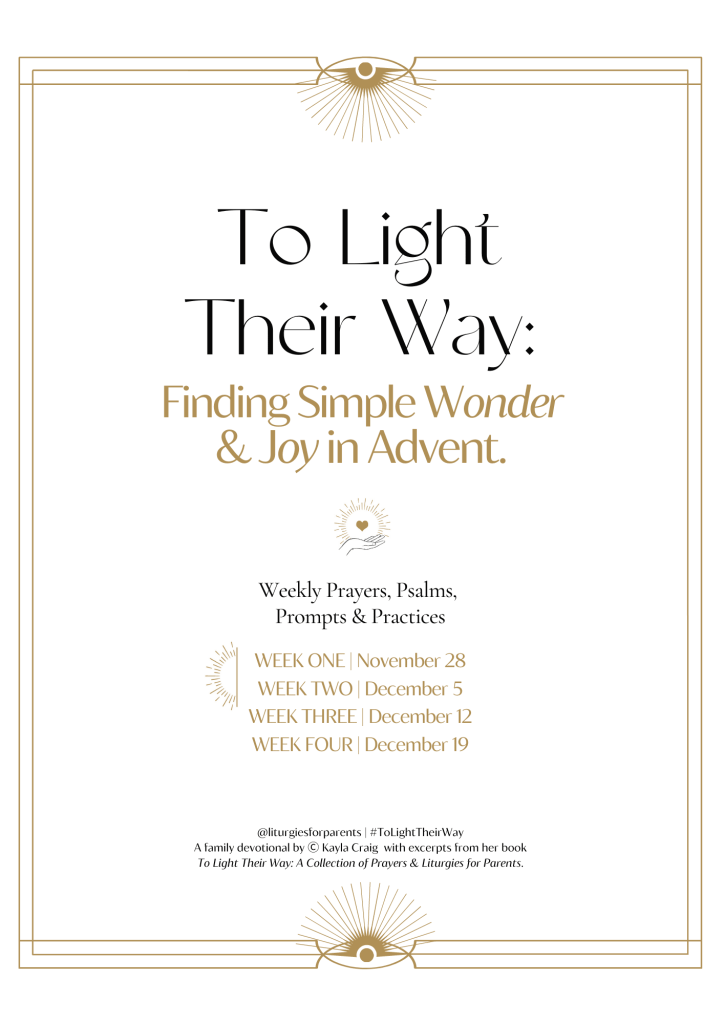
To Light Their Way: Finding Simple Wonder & Joy in Advent by Kayla Craig
A free Advent guide that Kayla made to complement her beautiful new book, To Light Their Way. In Kayla’s words: “I pray that “To Light Their Way: Finding Simple Wonder & Joy in Advent” guides you to the glittering hope in Christ alone. Each week includes snippets of more comprehensive prayers from To Light Their Way, along with a simple conversation/journal prompt, one tangible practice, & a breath prayer from a Psalm. Each week fits on one page and should hopefully add peace to your season — not add stress to your to-do list!”https://kaylacraig.substack.com/p/your-free-advent-download-is-ready?utm_medium=email&utm_campaign=cta
An Illustrated Advent for Families: God With Us by Illustrated Ministry
Illustrated Ministry is one of my favorite inclusive resources to use with children.
This digital download includes family devotions, coloring pages, and an advent calendar. (Choose the “personal use” pricing option if you are using this with your family.)
“The stories of Advent are stories for hard times. Jesus was born amid upheaval and historical change and among people who seemed powerless. But when the world feels hopeless, Advent reminds us God is with us: In chaos, God is with us. In suffering, God is with us. In uncertainty, God is with us. In whatever our family endures, God is with us.” https://store.illustratedministry.com/products/an-illustrated-advent-for-families-god-with-us?variant=39431416905826

Ministry
If your children are like mine and balk at sitting down with a traditional written devotional, these videos might be a good alternative. They are cute and funny and ask thoughtful questions about the meaning and practices of Advent and Christmas. You can stream them online with a free account from Redeem TV. (They also have a Roku app.) https://watch.redeemtv.com/whirl-ada-and-leo-s-inspired-christmas-adventures

Jesus Storybook Bible Advent Kit
If you have a Jesus Storybook Bible at home this family Advent resource is made just for you! This free download includes 24 printable Christmas ornaments, a reading plan for each day of December, a Christmas soundtrack, coloring pages, and printable memory cards. https://www.sallylloyd-jones.com/2021-advent/
Little Way Chapel Advent Bundle
“Little Way Advent is a 68-page guide for your family’s Advent journey. It is both a calendar and guidebook, featuring one practice per day to prepare your heart and home for the birth of Christ. The calendar is formatted as strips of paper that can be cut out and either placed inside the doors or pockets of a traditional Advent calendar, or made into a count down paper chain.”
https://www.littlewaychapel.com/printables/littleway-holiday-bundle

Faithful Families for Advent and Christmas by Traci Smith
“100 easy, fun, and meaningful ideas for bringing the sacred back into the season. (It’s) divided into three sections of prayers, practices, and lessons.” You can download it on Kindle through the link below or see if your library has a copy through Overdrive (Libby) or Hoopla.
https://smile.amazon.com/gp/aw/d/B08DG8PQW9/ref=tmm_kin_swatch_0?ie=UTF8&qid=1638107309&sr=8-3

Are you going to use any of these Advent resources this season? What are your favorite Advent devotionals to use for yourself or with your family?

Gospel, Holiday, Sermons

The Opposite of Love During the Holidays

The pressure to be loving at Christmas time is intense. We feel like we’re supposed to love the holiday season itself. Love the music. Love the lights. Love the parties. Love the worship services. Love the gifts.

We feel pressure to get together with our loved ones. All of them. Even when our schedules are full and our bodies are exhausted. Even the loved ones we don’t actually like. Even the ones who don’t like us. We feel pressure to show our love to each other through gifts-the shinier the better. Love is supposedly just all around us, infusing into us and out of us in the form of perfect Instagram photos, sparkly decorations and homemade gifts.

The truth is that for many of us, love is the hardest emotion to deal with around the holiday season. We feel a lot of things, but love seems out of our reach. We feel the ache and longing for a friend of family member that has died. We feel the pain of a relationship that is broken. We feel the disappointment of unmet expectations and crushed dreams. We feel the fear of uncertain futures. We feel a lot of things this time of year, but it’s possible that none of them are love. Maybe we even feel the opposite.

I discovered this week that there is apparently a raging debate on the Internet about what the opposite of love actually IS. Many people hold the traditional view that the opposite of love is hate. That animosity, cruelty, ill-will are the farthest you can get from true love. And those emotions can certainly come into play at Christmas time. I’ve seen and heard of families doing some cruel things to each other around the holidays. And as sad as it is, hatred in the form of wars, massacres, battles and murders are certainly no stranger to the holiday season.

Others tend more toward the thoughts of holocaust survivor Ellie Weisel, who said that the opposite of love is indifference. That the farthest thing away from the energy of love is the emptiness of apathy. I think many of us have experience with this around the Christmas season as well. We don’t feel love, but our hearts aren’t filled with hate. I mean, who even has the ENERGY to be hateful this time of year? Instead, what we feel is nothing. To protect ourselves from pain and loss, and uncertainty and loneliness we instead choose not to feel anything at all. We can’t care about anyone or anything because it hurts too much.  We are too hurt, our world feels too dangerous, our future seems too scary and so we fall into numbness, to apathy, to indifference to protect us from it all.

Perhaps both are true. Perhaps the opposite of love is simply “not love.” When you are exhausted, apathetic, wounded, fearful, hateful, angry or mourning, love can feel beyond your grasp. Because actually loving each other, and loving ourselves. is hard. Really, really, really hard. Nothing makes that more apparent than the sparkly, glitzy, consumeristic, eat-drink-and-be merry, Faux Love we find peddled so heavily during the holidays. Because when we are surrounded by fake love, it is easy to see where real love is lacking.

Because real Love is patient; real Love is kind; real Love is not envious or boastful or arrogant or rude. Real Love does not insist on its own way; it is not irritable or resentful; Real love does not rejoice in wrongdoing, but rejoices in the truth. (Sound familiar?)

It’s an incredible description–bordering on impossible.

Last week my kids and I watched Charlie Brown Christmas Tales on Netflix. In one scene Lucy comes up to Charlie Brown and Says “Merry Christmas Charlie Brown! At this time of year I think we should try to put aside all of our differences and try to be kind.” And Charlie Brown, looking at Lucy who bullies him most of the year says “Why does it have to be just this time of year? Why can’t it be all year round!” And Lucy balks “What are you? Some kind of fanatic!”

And that’s the truth isn’t it? Unlimited kindness and unconditional love is fanatical isn’t it? It’s why “let’s just smile and get along for the holidays” feels so awful–because love is never meant to stop and start.

Love is meant to be unrelenting., never ceasing, never failing. The Gospel, the Good news is that God is LOVE. That Jesus Christ came into the world as Love Incarnate, Love in the flesh to show us what a life of Love–what a kingdom of love looks like.  And we need it now more than ever. In ourselves, in our families, in our churches, in our communities and in our world. We need Love as a radical act of resistance against the false gospels of power, wealth, pride, selfishness and winning.

Love will be the hardest thing we ever do. It will be the most vulnerable thing we ever do. Nothing makes you more open to hurt than being patient, kind, humble, caring, and peaceful. Ask Jesus. Love got him killed. But love is also what has saved and is saving us all.  

It can feel all too big though. How can you love in the midst of all the chaos, all the anti-love, all the exhaustion, all the pain? How can you love when you don’t feel loving or even feel loved? As it turns out there is only one way to love, no matter if we are talking about loving our broken families, our rotting political systems, our fractured countries, or are wounded selves. We can only way in small ways. We can only love by choosing to do the next right thing. By choosing kindness, choosing peace, choosing patience, choosing humility, choosing to put others needs before own. Or as Mother Teresa said, “We can do not great things–only small things with great love.”

We cannot protect ourselves from pain. It is a universal part of the human experience. But the good news of the Gospel is that pain and love are NOT opposites. They can and do co-exist in this life. Mother Teresa called it a paradox. “I have found the paradox,” she said, “that if you love until it hurts, there can be no more hurt, only more love.” The radicalness of true love is that it can co-exist with our pain. The good news of Christmas is that the God who is Love Incarnate is with us in our hurt, in our loss, in our indifference and in our suffering– in the holiday seasons of Advent and Christmas and always.

Gospel, Parenting, Play

The Good, the Bad and the Superheroes

Until he’s prompted for more details, my four-year-old son’s report about his day at preschool always contains the same three elements: 1) If they had indoor or outdoor recess today, 2) what game he played at recess, (My favorite report was the day he said they played “salad.” “Salad?” “Yeah, we used leaves and pretended to make a salad. Then we played police officers.” “Okay then.”) and 3) If he got in trouble at recess that day. His most frequent recess infraction involves throwing wood chips. (For the love, child, what’s so great about throwing wood chips? Stop it already.) 

I love that he feels safe enough with me to tell me when he messes up. And my policy (so far) is that he never gets in trouble at home for something that happened at school. This is because, first of all, his awesome teachers have school under control, but more importantly, because I want his unguarded honesty with me to last as long as possible. Preferably a lifetime. We do talk about what happened, however, thinking through how that made all the people involved feel, and what he could do differently in the future. (We have also written the occasional apology note or created an apology video when it seemed appropriate.)

This week, my son told me he got in trouble for hitting a friend at recess. When pressed for further details, he explained that he and his regular crew of recess friends were playing Superheroes, an ever-popular game among preschool boys, and he was the Hulk.

“Mom. I was just being the Hulk,” he said. “When you’re the Hulk you have to Hulk Smash the bad guys and stop them.”

I paused and looked at him in the rear view mirror. “Honey, when you’re hurting someone, you aren’t stopping the bad guys. You are BEING the bad guy.”

He blinked at me.

“Superheroes help people,” I explained. “They are the good guys (and gals) because they are doing good things. When they hurt other people, even if those people are the bad guys, they aren’t being superheroes anymore.”

It’s a hard lesson to learn at the age of four. I see many adults struggling with the concept. There’s no title or position you can hold, no reputation you can acquire, or party or organization you can join that automatically makes everything you do good. A wrong choice is a wrong choice, no matter who makes it.

The world isn’t divided into “good guys” and “bad guys,” despite the story that comic books and modern politics want to sell you. You are only being a good person when you are doing good things. Things like showing love and kindness, practicing generosity and hospitality, and extending mercy and grace. If you do 99 wonderful things in a row, and then make 1 horrible, harmful choice, that action doesn’t suddenly become okay just because it was done by someone who has done 99 good things. It’s still wrong.

When a political leader protects the rights of one vulnerable group of people, but allows the bombing of another, it’s still wrong. When a country engages in acts of torture, even under the auspices of national security, it’s still evil. If a religious leader brings hope to thousands, but alienates his own family, that’s never okay. If an entrepreneur creates a useful and beautiful product, but hurts the factory workers or the environment in the production process, the harm is still real.  If social activists work to bring positive changes, but silence minority voices in the process, it’s still causes lasting damage.

The good news is that the reverse is also true. If you make 99 bad, hurtful decisions in a row (something that would  most certainly get you labeled as a Bad Guy), but then make one authentic good choice, that one action still counts.  Will it undo the 99 harmful things you’ve done? Unlikely. Will people automatically trust you and rally around you? They probably shouldn’t. But choosing compassion over fear, or kindness over indifference, is never a wasted action. You can choose to be the Good Guy at any crossroads, even if it’s a path of bad decisions that led you to that particular decision point.  And that truth is a deep and powerful grace.

We all want to be the heroes in our own story, and often, the quickest way to to this feeling is to cast yourself as the good superhero, fighting against a swarm of villains.  But life doesn’t work that way. There IS both Good and Evil in the world, but they are each contained in all of us. We all have potential to bring light to everyone around us, but we must never forget we always have the capacity to amplify the darkness as well.

The true superheroes are the ones who relentlessly do the next right thing, even when they know that their position or reputation might give them a pass, or even a mandate, for a poor decision. They chose love and peace, even when it’s unpopular or inconvenient.

The true superheroes are the ones who are unafraid to praise the good that is done by people or groups with whom they normally find themselves at odds. They know that acknowledging goodness and truth from any source only brings more goodness into the world.

Our true allies are not the people that claim the same beliefs or embrace the same team. They are those who act in ways that make the world a more compassionate, welcoming place. Jesus called those people our neighbors.

But whether you think of these people as neighbors, good guys (and gals), or superheroes, the most important thing is not how you label one, it’s that you set your mind, body and spirit on becoming one.

Faith, Gospel, Kingdom of God, Sermons, Vulnerability

Ordinary But Remarkable Things

As an associate pastor, I usually preach at my church only about 4 or 5 times a year. This Sunday was one of those days. I always take preaching seriously, but after the world events of this past week, I felt the weight of the task of preaching even more than usual. What do you say at a time like this? Was I even the right voice to be speaking at such a moment? I confessed to the congregation that I experienced many moments of self doubt this week. Maybe on a day like today the church needed to hear with someone with more experience as a preacher, someone more polished. Perhaps they needed to hear from someone older, someone wiser, someone who was less emotionally raw right now. 

But when I quieted these voices of doubt, I realized, of course, there was no one else for this task. There are other, better, more-experienced preachers than me in the world, but none of these preachers had been called to preach at this place in this moment in time. For better or for worse, this was my work to do today. 

So I made a deal with the congregation. I would push through my doubts and insecurities, and do the work God had called me to do this week, if they would also do theirs. I don’t know what their work is this week, maybe there is a conversation they need to have, a phone call to make, a gift to give,  a neighbor to serve, or a stranger to reach out to. But I know everyone has something they know is the next right thing for them to do, but they haven’t it yet done. They are afraid it will be awkward, or they’ll do it imperfectly. They are afraid someone else has already done it better or it won’t make a difference anyway. And it’s likely that some of that will be true, awkwardly and imperfectly is about the only way I know how to do anything, but we need to do those things anyways. So I said “I’ll do my work, if you’ll do yours.” And they agreed. So I did. 

And my work  was to read, sit with, and preach this week’s Lectionary Gospel passage: Matthew, Chapter 5:1-12. 

Matthew was not the first of the four Gospels to be written, but it is the first by arrangement in our New Testament. Meaning, that if you had never read the Bible before, and decided to open up the New Testament to the first page and start reading, your first introduction to the life of Christ would be Matthew’s account. But I don’t want to start in Chapter 5, I want to start at the beginning, because context ALWAYS matters.

The setting of the Gospel of Matthew is a little over 2000 years ago in Roman-occupied Palestine. Once again, the Jewish people have found themselves subjects of foreign rule,  echoing the conquests and exiles their ancestors experienced before them. In those days, the Roman Empire was prosperous both economically and militarily, and for sure some of the Jewish people were faring well under the Roman Regime. There were those who had been able to maneuver their way into positions of relative power, becoming local rulers that let the province of Judea operate somewhat autonomously as long as the Emperor was happy. There were those who had accepted jobs as tax collectors, securing the payments Rome demanded, plus extra for themselves. There were wealthy landowners, who were becoming wealthier by the day as they scooped up small bits of land that their fellow Jews had to forfeit when they couldn’t pay Caesar what was owed.

But for many, the injustice of living in occupied territory was compounded by daily economic burdens and insecurities. And like all oppressed and disadvantaged groups, different factions reacted to the political and economic reality in different ways. Some, like the Zealots, rose up in violent revolutions, while others, like the Sadducees took a more pragmatic and compromising approach. The Pharisees chose a path of religious puritanism, while the Essenes opted out altogether, taking a monastic, counter-cultural approach. But regardless of the method, nearly everyone was looking for answers, for a solution, for a savior.

It’s in that atmosphere that the Gospel of Matthew begins, and it seems clear from the start that Matthew is setting us up to expect great things from this man Jesus. If the people are looking for a savior to right the wrongs of their age, then maybe this is the hero they’ve been waiting for.

Chapter 1 admittedly gets off to a slow start, with a less-than-exciting, but quite impressive, genealogy for Jesus. It’s a Royal lineage that includes some of the most important people from Jewish history: the Patriarchs, Abraham, Isaac and Jacob, the great Kings David and Solomon, and the strong brave women of Tamar, Ruth, Queen Bathsheba and his mother Mary. Someone from this line should do well, and our expectations rise.

But now Matthew’s account really begins to unfold. Following the genealogy is the pronouncement of Jesus’ birth, by no less than an angel. The stars themselves announce Jesus arrive, which brings the young family a visit from the Magi, who bring expensive gifts and pay homage to the newborn king. Chapter 2 continues the action with a divinely inspired dream that leads to a dramatic flight to Egypt by the holy family to escape the wrath of the local ruling king, Herod.

After a few years, Joseph and Mary move their family again to Nazareth, a rural town in the district of Galilee, but Matthew skips over this presumably quiet period of Jesus’ life. Instead, the story picks up his story again with Jesus as a young adult, being baptized by the eccentric, locust-eating prophet, John, marking the official beginning of Jesus’ public life. And if you were still having doubts that this is the Chosen One, Matthew writes that as Jesus comes out of the water, the heavens open up, the Spirit of God descends like a dove, and a voice booms from Heaven declaring “This is my Son, the Beloved, with whom I am well pleased.” It’s hardly subtle.

And so it would seem that Jesus is poised for greatness after his dramatic rise. He’s been marked as a king from before his birth. And he seems to be charismatic, drawing curious crowds with minimal effort, who are waiting to see what path he will take. Will he lead an armed rebellion or set his sights on becoming a powerful political insider? Will he preach the importance of religious purity or the necessity of complete separation from secular society? Jesus appears to be just a few short steps away turn this buzzing energy into a movement: gathering the right supporters, securing the right backers, crafting a resonating message. The stage is nearly set for a divinely appointed leader to right the wrongs against the people of God.

But even for messiahs, the path forward is never a red carpet. It is always a crossroads. There are always decisions to be made. No one escapes the small, daily choices that form the moral arch of our lives. Not even the Son of God.

In Chapter 4 of Matthew, Jesus finds himself alone in wilderness with decisions to make.  He’s offered unlimited power and unthrottled ambition. A path to a life of unending and untroubled comfort is laid out for him.  They are good offers. A person in that position could not only liberate an oppressed people, they could topple an empire. If anyone could appropriately handle the endless ethical gray areas that such a life would bring, surely it would be the divinely appointed descendant of Kings and Patriarchs.

But Jesus says no to this deal with the devil.  And suddenly, after four chapters of dramatic setup, Matthew’s unfolding account of the life of Jesus’ life no longer seems to be following the traditional hero’s arch. At the point in the narrative where Jesus should be gathering a following of the strong and powerful, Jesus begins to gather a group of outsiders, blue-collar workers (actually, NO collar, no SHIRT kind of workers). When he should be scheduling dinner meetings to secure rich donors, he instead spends his time in the homes of the quarantined and the contagious, and in the makeshift shelters of the run-out-of-town.

The crowds are still there. But they are starting to get confused. Where there should be a clear message about how it’s time for the Jewish people to reclaim the land that is rightfully theirs, instead Jesus is talking about repenting, a Kingdom of Heaven, and fuzzy metaphors (they hope they’re metaphors) about being fishers of men.

Perhaps these ideas were *just* intriguing enough to an oppressed and miserable people. Perhaps they were just enjoying the distraction from daily life. Maybe it was the rumors that the sick and suffering people Jesus was spending time with were actually being healed.  Whatever it was, despite the obvious missteps away from the well-traveled path, people continued to gather around Jesus, asking to hear more.

And so in Chapter 5 of the Gospel of Matthew, we find the first full sermon from Jesus that we have in our Bible. It’s often called the Sermon on the Mount, named after its physical location, and our scripture passage for today is the beginning of it–Nine blessings often called the Beatitudes:

 “Blessed are the poor in spirit, for theirs is the kingdom of heaven.

“Blessed are those who mourn, for they shall be comforted.

“Blessed are the gentle, for they shall inherit the earth.

“Blessed are those who hunger and thirst for righteousness, for they shall be satisfied.

“Blessed are the merciful, for they shall receive mercy.

“Blessed are the pure in heart, for they shall see God.

“Blessed are the peacemakers, for they shall be called sons of God.

10 “Blessed are those who have been persecuted for the sake of righteousness, for theirs is the kingdom of heaven.

11 “Blessed are you when people insult you and persecute you, and falsely say all kinds of evil against you because of Me. 12 Rejoice and be glad, for your reward in heaven is great; for in the same way they persecuted the prophets who were before you.”

These are hardly the opening lines of a sermon that galvanizes a loud and conspicuous movement. These words aren’t particularly stimulating or really even that encouraging. They aren’t nostalgic for a better past or a strong warning about a dark future. And if these are calls to action, Jesus has really missed the mark. No one is going to set out to mourn, or be poor in spirit, or to be insulted or persecuted.

But these nine blessings are not goals, they are not prescriptions, they are DESCRIPTIONS. They are adjectives that describe the lives of people who follow a loving and holy God. They are moments in time that everyone who truly lives in the way of Jesus will experience.

In the Godly Play lesson about the Beatitudes, the story describes these nine statements, as the “ordinary but remarkable things people do that bless everyone.” Ordinary but remarkable things.

And through that lens we suddenly see the opening scenes in Matthew’s Gospel in an entirely new way. We flash back to see that this is not just the tale of one extraordinary life destined for greatness, though it IS that. But now we see that Matthew’s story is also about the ordinary lives of MANY God-seekers and God followers who made difficult choices with remarkable integrity, faith, courage, and love.

It’s the story of a young working-class couple, living lives far removed from the kings and patriarchs in their family tree, saying yes to a risky, life-altering call from God. It’s the story of a group of astrologers, taking a long, uncomfortable  journey, crossing religious and political boundaries, to bring gifts to a new king that they couldn’t be certain even really existed. It’s the story of a frightened family, leaving behind everything they’ve known, taking on lives as refugees in a foreign land in hopes of saving the life of their son. It’s the story of two cousins, each peculiar and charismatic in his own way, coming together at the water’s edge to declare the radical message of repentance and of an Upside Down Kingdom.  It’s the story of a young prophet, alone in the wilderness, facing, and rejecting, extraordinary but familiar temptations.

Matthew’s been telling a different kind of story all along. It IS the story of a Messiah, on a journey to bring justice, and peace, and liberation. But it is also the story of an incarnate God-become-flesh who shows us that although there are times that call for extraordinary actions, the Kingdom of Heaven cannot be brought by a military revolution or a political takeover. Jesus shows us that grace and peace are given by God, not governments, and that no wall can keep them out.

We misunderstand the Beatitudes when we add them to our To Do lists. The message of these blessings is that if you are seeking God, then you do not need to ALSO seek the experiences Jesus described. For better or for worse, they will find you. If you are daily choosing to say yes to God at work in your life, then these descriptions should sound familiar. If your response to the Christ’s call to participate in redemptive love is to say, “I don’t totally understand it, but I know I want to be a part of it,” then you will find snapshots of your life in these words.

You will know that you are living an extraordinary life of love, when you find yourself facing the common experience of mourning, because no one who has loved deeply can avoid grief in a broken world. And to grieve well, in a world that is uncomfortable with such a daring act of vulnerability and honesty, is a blessing to everyone.

You will know that you are living a life of mercy, when you find yourself moved with compassion and humbly seeking justice for all people. You will know you are truly imitating Christ, when you find yourself engaged in the ordinary, remarkable acts of peacemaking in a world that would rather you be satisfied with keeping the peace.

There’s no need to go searching for persecution, or insults, or personal attacks. If you are living a life of grace, then those who are threatened by the equality and radical inclusion of God’s love will call you a loser, label you unintelligent, and dismiss you as unimportant.

Not only do the Beatitudes boldly acknowledge that the life of anyone who follows Jesus will be marked with ordinary ups and downs, by both accomplishments and injustices. They also share the extraordinary message of Jesus that in ALL of it, the living of your ordinary life, that you are blessed by God.

God’s Kingdom is always open to you, no matter your gender, sexual orientation, race, or country of origin. God’s grace means the world CAN be changed by ordinary people who just relentlessly do the next right thing. That is good news indeed. And as I’m sure the author of Matthew’s Gospel would agree, it’s a story worth telling.