Blog

Organization, Recommendations, To Do Lists

How Did I Live Without This? (Trello Edition)

I love a good recommendation. I love it when friends and family recommend awesome things to me. I love getting to recommend amazing things to my friends. It’s just such an easy way to spread the love and make everybody’s life a little better.

Got a favorite recipe? Tell me! Tried a new fantastic restaurant? Do share! Know a secret Microsoft Excel hack? Send it to me right now! Found an amazing new podcast? I’m already mad you didn’t tell me sooner. Gotta tool that’s helping you simplify and organize? Do not wait one more second before telling me about it!

And when I get a recommendation for something that’s an immediate game-changer? Now you are speaking my love language. All the heart eyes for the person who shared it with me. And then you know it’s only a matter of time before I’m gushing about my new-to-me, life-changing discovery on social media, and in person, with, well, everybody.

And guess what? That time has come. I’ve got a recommendation for you! My new favorite organization tool is  TRELLO! I first heard about it where I hear about A LOT of the awesome new things in my life–The Sorta Awesome Show podcast.  First from Laura Tremaine, then from Meg Tietz.

Laura described Trello as the Pinterest of organizational tools, and I think that’s pretty accurate. Trello describes itself by saying “A Trello board is a list of lists, filled with cards, used by you and your team. It’s a lot more than that, though. Trello has everything you need to organize projects of any size.”

In Trello you organize things by Boards (think a virtual bulletin board). Then each Board contains Lists (think pieces of paper pinned to the board). Each List contains Cards (think sticky notes stuck on the papers). You can drag and drop cards and lists around easily as needed. And each board can have it’s own background color or image (with hundreds of gorgeous photos to choose from!) which makes Trello especially visually pleasing.

Trello is FREE for the basic version, and so far I’m completely happy with it as is. It is fully functional and doesn’t feel like a “lite” version of an app at all.  With the free version you get one “Power-Up” (bonus functions like syncing with your Google calendar or Drive, adding polls or surveys, or even GIFs) per board. If you upgrade the the Gold  (paid) version you get to add multiple Power-Ups per board. (I haven’t tried that yet, but I can see how that could be useful!)

Trello can be used individually or collaboratively with a team. (A team could be your family!) You can use it on your computer or via the app on your phone, and the two sync together perfectly.

Here’s some of the ways I’m using Trello to keep myself organized.

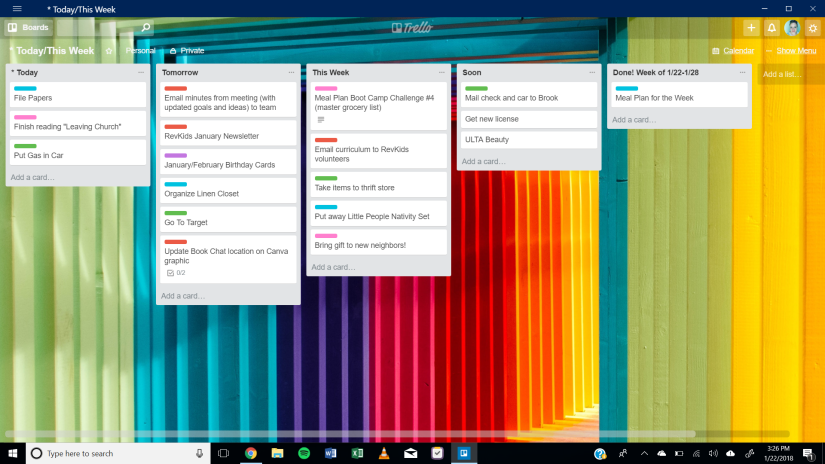
1: Daily/Weekly To do List

Trello To Do.png

The pretty photo backgrounds are part of what I love about Trello. But more importantly, Trello gives me an easy way to see what’s on my to do list for today, tomorrow, and the week. The colored-coded labels help me to easily see if this is an item for home, work, my kids, or an errand that needs to be run. Each item is what Trello calls a card and can easily be dragged and dropped between lists (or even boards) as needed. My favorite thing is dragging a to do list item to the “DONE!” list and then archiving that entire list at the end of the week.

2: Meal Planning

Meal Plan To Do

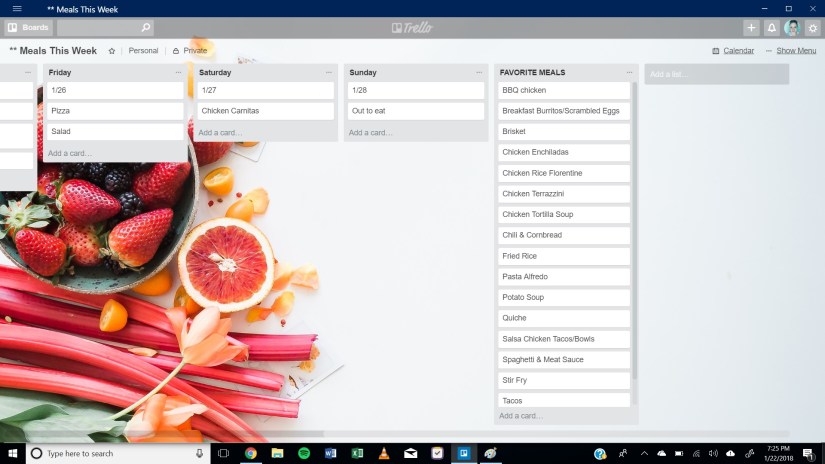
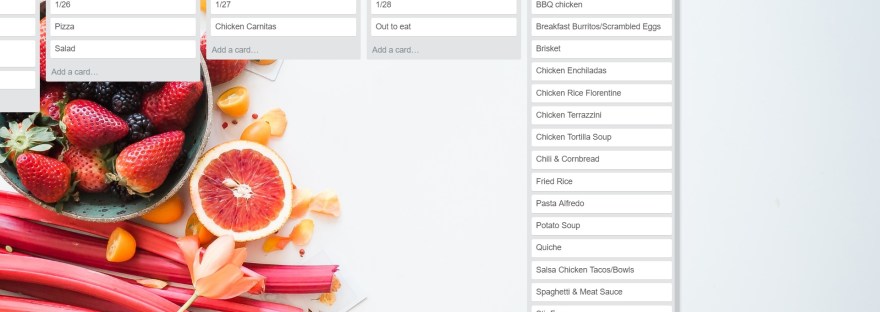
On my “Meals for This Week” board I have a list for every day of the week plus another  list of favorite meals that are currently in heavy rotation at this house. (Can you tell from the meal list that it is very much winter right now? So many warm comfort foods on there.) 

At the beginning of each week I change the top card on each list to reflect the correct date and then either drag and drop meal cards from my favorites list to each day, or add a new card if I’m branching out.

Change of plans? It’s super easy to just drag a meal to a new day, or back to the favorites list for use another time.

3: Organizing Ideas and Projects

Tello Home

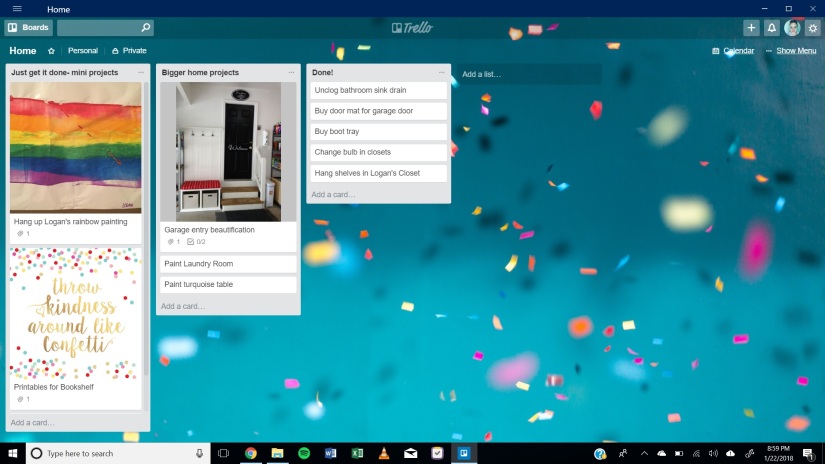
Trello is a great place to keep (and organize!) all kinds of ideas, from work projects, home improvement dreams, to lists of future blog posts. Since each card can have a photo or file attachment, its own checklist, or additional notes, it’s easy to keep track of big ideas and tiny details.

Do you use Trello? I’d love to hear the ways you are using Trello, or a similar tool, to keep your life and your ideas organized! Share a screenshot or description in the comments below. 

If you haven’t used it yet, give Trello a try and tell me what you think!

*P.S. If you use one of my links above to try Trello it will help me earn a free month of TRELLO Gold (their paid version) to try. Then you can get a link to share with your friends to earn the same. I am not earning any money by sharing this, and this post is not sponsored by TRELLO in any way. They, like the rest of the Internet, do not know that I exist.


Justice, Kingdom of God, Peacemaking

Love Must Be Louder

I confess that I’ve never been to Haiti, El Salvador, or any of the many countries in Africa, although I hope to one day. But I don’t have to have been there personally to know that these places are full of beautiful, diverse people made in the image of God. Beauty exists everywhere, even in, especially in, places where hardship is plentiful. We in the U.S. should know this as well as anyone.

It’s unequivocally evil to denigrate and devalue entire countries, continents, and peoples. That evil is compounded when it comes from the leaders (both those who speak and those who agree by their silence) of a country whose longstanding policies, actions, and attitudes have, and continue to, directly contribute to the hardships of these very people.

To my friends around the globe who live in, grew up in, love someone in, have ancestry in, have cherished memories in these beautiful places, I am so, so sorry that a vocal portion of our country places so little value on the people and places you love. It is wrong. Please know that you are not alone as you hope for and work for a country and a world that is a welcoming and grace-filled place for everyone.

I am committed to calling out, voting out, actioning out the people and policies that let racism and other forms of evil flourish. I am committed to truthing out and loving out these same evils in my own heart and in my community.

These are hard words to write because I know that my words and actions will never be enough. There is always more that I could be doing, that someone else *thinks* I should be doing. (Often that someone else is me.)

Does that mean I will write an impassioned social media post every time the news reports someone doing or saying something awful? No. I don’t even think I should.

Will I attend every rally, march and meeting across the city where people are working hard to overcome racism, xenophobia, and other systemic evils? No. I couldn’t possibly.

But I can do *something* every day. Something to promote love and inclusion. Something to fight against hate. Some of my actions will be flawed. Some of them will fail. And I have to believe that’s okay.

I confess that when I know I am going to do something imperfectly, my strongest tendency is just not to take any action at all. But this is too important to stay silent. It’s too important to not do anything. When hate is loud, love must be louder. We have to go forward, imperfectly peacemaking because the alternative is perfect acquiescence to evil.

Today my peacemaking actions reflecting on the challenging words of Martin Luther King, Jr., updating my voter registration, and (re)reading another chapter of Osheta Moore’s beautiful book Shalom Sistas to be reminded of the peacemaking steps I can take on the path of my ordinary life.

What are your peacemaking actions for today? Let’s cheer each other on.

Gospel, Holiday, Sermons

The Opposite of Love During the Holidays

The pressure to be loving at Christmas time is intense. We feel like we’re supposed to love the holiday season itself. Love the music. Love the lights. Love the parties. Love the worship services. Love the gifts.

We feel pressure to get together with our loved ones. All of them. Even when our schedules are full and our bodies are exhausted. Even the loved ones we don’t actually like. Even the ones who don’t like us. We feel pressure to show our love to each other through gifts-the shinier the better. Love is supposedly just all around us, infusing into us and out of us in the form of perfect Instagram photos, sparkly decorations and homemade gifts.

The truth is that for many of us, love is the hardest emotion to deal with around the holiday season. We feel a lot of things, but love seems out of our reach. We feel the ache and longing for a friend of family member that has died. We feel the pain of a relationship that is broken. We feel the disappointment of unmet expectations and crushed dreams. We feel the fear of uncertain futures. We feel a lot of things this time of year, but it’s possible that none of them are love. Maybe we even feel the opposite.

I discovered this week that there is apparently a raging debate on the Internet about what the opposite of love actually IS. Many people hold the traditional view that the opposite of love is hate. That animosity, cruelty, ill-will are the farthest you can get from true love. And those emotions can certainly come into play at Christmas time. I’ve seen and heard of families doing some cruel things to each other around the holidays. And as sad as it is, hatred in the form of wars, massacres, battles and murders are certainly no stranger to the holiday season.

Others tend more toward the thoughts of holocaust survivor Ellie Weisel, who said that the opposite of love is indifference. That the farthest thing away from the energy of love is the emptiness of apathy. I think many of us have experience with this around the Christmas season as well. We don’t feel love, but our hearts aren’t filled with hate. I mean, who even has the ENERGY to be hateful this time of year? Instead, what we feel is nothing. To protect ourselves from pain and loss, and uncertainty and loneliness we instead choose not to feel anything at all. We can’t care about anyone or anything because it hurts too much.  We are too hurt, our world feels too dangerous, our future seems too scary and so we fall into numbness, to apathy, to indifference to protect us from it all.

Perhaps both are true. Perhaps the opposite of love is simply “not love.” When you are exhausted, apathetic, wounded, fearful, hateful, angry or mourning, love can feel beyond your grasp. Because actually loving each other, and loving ourselves. is hard. Really, really, really hard. Nothing makes that more apparent than the sparkly, glitzy, consumeristic, eat-drink-and-be merry, Faux Love we find peddled so heavily during the holidays. Because when we are surrounded by fake love, it is easy to see where real love is lacking.

Because real Love is patient; real Love is kind; real Love is not envious or boastful or arrogant or rude. Real Love does not insist on its own way; it is not irritable or resentful; Real love does not rejoice in wrongdoing, but rejoices in the truth. (Sound familiar?)

It’s an incredible description–bordering on impossible.

Last week my kids and I watched Charlie Brown Christmas Tales on Netflix. In one scene Lucy comes up to Charlie Brown and Says “Merry Christmas Charlie Brown! At this time of year I think we should try to put aside all of our differences and try to be kind.” And Charlie Brown, looking at Lucy who bullies him most of the year says “Why does it have to be just this time of year? Why can’t it be all year round!” And Lucy balks “What are you? Some kind of fanatic!”

And that’s the truth isn’t it? Unlimited kindness and unconditional love is fanatical isn’t it? It’s why “let’s just smile and get along for the holidays” feels so awful–because love is never meant to stop and start.

Love is meant to be unrelenting., never ceasing, never failing. The Gospel, the Good news is that God is LOVE. That Jesus Christ came into the world as Love Incarnate, Love in the flesh to show us what a life of Love–what a kingdom of love looks like.  And we need it now more than ever. In ourselves, in our families, in our churches, in our communities and in our world. We need Love as a radical act of resistance against the false gospels of power, wealth, pride, selfishness and winning.

Love will be the hardest thing we ever do. It will be the most vulnerable thing we ever do. Nothing makes you more open to hurt than being patient, kind, humble, caring, and peaceful. Ask Jesus. Love got him killed. But love is also what has saved and is saving us all.  

It can feel all too big though. How can you love in the midst of all the chaos, all the anti-love, all the exhaustion, all the pain? How can you love when you don’t feel loving or even feel loved? As it turns out there is only one way to love, no matter if we are talking about loving our broken families, our rotting political systems, our fractured countries, or are wounded selves. We can only way in small ways. We can only love by choosing to do the next right thing. By choosing kindness, choosing peace, choosing patience, choosing humility, choosing to put others needs before own. Or as Mother Teresa said, “We can do not great things–only small things with great love.”

We cannot protect ourselves from pain. It is a universal part of the human experience. But the good news of the Gospel is that pain and love are NOT opposites. They can and do co-exist in this life. Mother Teresa called it a paradox. “I have found the paradox,” she said, “that if you love until it hurts, there can be no more hurt, only more love.” The radicalness of true love is that it can co-exist with our pain. The good news of Christmas is that the God who is Love Incarnate is with us in our hurt, in our loss, in our indifference and in our suffering– in the holiday seasons of Advent and Christmas and always.

Gospel, Parenting, Play

The Good, the Bad and the Superheroes

Until he’s prompted for more details, my four-year-old son’s report about his day at preschool always contains the same three elements: 1) If they had indoor or outdoor recess today, 2) what game he played at recess, (My favorite report was the day he said they played “salad.” “Salad?” “Yeah, we used leaves and pretended to make a salad. Then we played police officers.” “Okay then.”) and 3) If he got in trouble at recess that day. His most frequent recess infraction involves throwing wood chips. (For the love, child, what’s so great about throwing wood chips? Stop it already.) 

I love that he feels safe enough with me to tell me when he messes up. And my policy (so far) is that he never gets in trouble at home for something that happened at school. This is because, first of all, his awesome teachers have school under control, but more importantly, because I want his unguarded honesty with me to last as long as possible. Preferably a lifetime. We do talk about what happened, however, thinking through how that made all the people involved feel, and what he could do differently in the future. (We have also written the occasional apology note or created an apology video when it seemed appropriate.)

This week, my son told me he got in trouble for hitting a friend at recess. When pressed for further details, he explained that he and his regular crew of recess friends were playing Superheroes, an ever-popular game among preschool boys, and he was the Hulk.

“Mom. I was just being the Hulk,” he said. “When you’re the Hulk you have to Hulk Smash the bad guys and stop them.”

I paused and looked at him in the rear view mirror. “Honey, when you’re hurting someone, you aren’t stopping the bad guys. You are BEING the bad guy.”

He blinked at me.

“Superheroes help people,” I explained. “They are the good guys (and gals) because they are doing good things. When they hurt other people, even if those people are the bad guys, they aren’t being superheroes anymore.”

It’s a hard lesson to learn at the age of four. I see many adults struggling with the concept. There’s no title or position you can hold, no reputation you can acquire, or party or organization you can join that automatically makes everything you do good. A wrong choice is a wrong choice, no matter who makes it.

The world isn’t divided into “good guys” and “bad guys,” despite the story that comic books and modern politics want to sell you. You are only being a good person when you are doing good things. Things like showing love and kindness, practicing generosity and hospitality, and extending mercy and grace. If you do 99 wonderful things in a row, and then make 1 horrible, harmful choice, that action doesn’t suddenly become okay just because it was done by someone who has done 99 good things. It’s still wrong.

When a political leader protects the rights of one vulnerable group of people, but allows the bombing of another, it’s still wrong. When a country engages in acts of torture, even under the auspices of national security, it’s still evil. If a religious leader brings hope to thousands, but alienates his own family, that’s never okay. If an entrepreneur creates a useful and beautiful product, but hurts the factory workers or the environment in the production process, the harm is still real.  If social activists work to bring positive changes, but silence minority voices in the process, it’s still causes lasting damage.

The good news is that the reverse is also true. If you make 99 bad, hurtful decisions in a row (something that would  most certainly get you labeled as a Bad Guy), but then make one authentic good choice, that one action still counts.  Will it undo the 99 harmful things you’ve done? Unlikely. Will people automatically trust you and rally around you? They probably shouldn’t. But choosing compassion over fear, or kindness over indifference, is never a wasted action. You can choose to be the Good Guy at any crossroads, even if it’s a path of bad decisions that led you to that particular decision point.  And that truth is a deep and powerful grace.

We all want to be the heroes in our own story, and often, the quickest way to to this feeling is to cast yourself as the good superhero, fighting against a swarm of villains.  But life doesn’t work that way. There IS both Good and Evil in the world, but they are each contained in all of us. We all have potential to bring light to everyone around us, but we must never forget we always have the capacity to amplify the darkness as well.

The true superheroes are the ones who relentlessly do the next right thing, even when they know that their position or reputation might give them a pass, or even a mandate, for a poor decision. They chose love and peace, even when it’s unpopular or inconvenient.

The true superheroes are the ones who are unafraid to praise the good that is done by people or groups with whom they normally find themselves at odds. They know that acknowledging goodness and truth from any source only brings more goodness into the world.

Our true allies are not the people that claim the same beliefs or embrace the same team. They are those who act in ways that make the world a more compassionate, welcoming place. Jesus called those people our neighbors.

But whether you think of these people as neighbors, good guys (and gals), or superheroes, the most important thing is not how you label one, it’s that you set your mind, body and spirit on becoming one.

Faith, Gospel, Kingdom of God, Sermons, Vulnerability

Ordinary But Remarkable Things

As an associate pastor, I usually preach at my church only about 4 or 5 times a year. This Sunday was one of those days. I always take preaching seriously, but after the world events of this past week, I felt the weight of the task of preaching even more than usual. What do you say at a time like this? Was I even the right voice to be speaking at such a moment? I confessed to the congregation that I experienced many moments of self doubt this week. Maybe on a day like today the church needed to hear with someone with more experience as a preacher, someone more polished. Perhaps they needed to hear from someone older, someone wiser, someone who was less emotionally raw right now. 

But when I quieted these voices of doubt, I realized, of course, there was no one else for this task. There are other, better, more-experienced preachers than me in the world, but none of these preachers had been called to preach at this place in this moment in time. For better or for worse, this was my work to do today. 

So I made a deal with the congregation. I would push through my doubts and insecurities, and do the work God had called me to do this week, if they would also do theirs. I don’t know what their work is this week, maybe there is a conversation they need to have, a phone call to make, a gift to give,  a neighbor to serve, or a stranger to reach out to. But I know everyone has something they know is the next right thing for them to do, but they haven’t it yet done. They are afraid it will be awkward, or they’ll do it imperfectly. They are afraid someone else has already done it better or it won’t make a difference anyway. And it’s likely that some of that will be true, awkwardly and imperfectly is about the only way I know how to do anything, but we need to do those things anyways. So I said “I’ll do my work, if you’ll do yours.” And they agreed. So I did. 

And my work  was to read, sit with, and preach this week’s Lectionary Gospel passage: Matthew, Chapter 5:1-12. 

Matthew was not the first of the four Gospels to be written, but it is the first by arrangement in our New Testament. Meaning, that if you had never read the Bible before, and decided to open up the New Testament to the first page and start reading, your first introduction to the life of Christ would be Matthew’s account. But I don’t want to start in Chapter 5, I want to start at the beginning, because context ALWAYS matters.

The setting of the Gospel of Matthew is a little over 2000 years ago in Roman-occupied Palestine. Once again, the Jewish people have found themselves subjects of foreign rule,  echoing the conquests and exiles their ancestors experienced before them. In those days, the Roman Empire was prosperous both economically and militarily, and for sure some of the Jewish people were faring well under the Roman Regime. There were those who had been able to maneuver their way into positions of relative power, becoming local rulers that let the province of Judea operate somewhat autonomously as long as the Emperor was happy. There were those who had accepted jobs as tax collectors, securing the payments Rome demanded, plus extra for themselves. There were wealthy landowners, who were becoming wealthier by the day as they scooped up small bits of land that their fellow Jews had to forfeit when they couldn’t pay Caesar what was owed.

But for many, the injustice of living in occupied territory was compounded by daily economic burdens and insecurities. And like all oppressed and disadvantaged groups, different factions reacted to the political and economic reality in different ways. Some, like the Zealots, rose up in violent revolutions, while others, like the Sadducees took a more pragmatic and compromising approach. The Pharisees chose a path of religious puritanism, while the Essenes opted out altogether, taking a monastic, counter-cultural approach. But regardless of the method, nearly everyone was looking for answers, for a solution, for a savior.

It’s in that atmosphere that the Gospel of Matthew begins, and it seems clear from the start that Matthew is setting us up to expect great things from this man Jesus. If the people are looking for a savior to right the wrongs of their age, then maybe this is the hero they’ve been waiting for.

Chapter 1 admittedly gets off to a slow start, with a less-than-exciting, but quite impressive, genealogy for Jesus. It’s a Royal lineage that includes some of the most important people from Jewish history: the Patriarchs, Abraham, Isaac and Jacob, the great Kings David and Solomon, and the strong brave women of Tamar, Ruth, Queen Bathsheba and his mother Mary. Someone from this line should do well, and our expectations rise.

But now Matthew’s account really begins to unfold. Following the genealogy is the pronouncement of Jesus’ birth, by no less than an angel. The stars themselves announce Jesus arrive, which brings the young family a visit from the Magi, who bring expensive gifts and pay homage to the newborn king. Chapter 2 continues the action with a divinely inspired dream that leads to a dramatic flight to Egypt by the holy family to escape the wrath of the local ruling king, Herod.

After a few years, Joseph and Mary move their family again to Nazareth, a rural town in the district of Galilee, but Matthew skips over this presumably quiet period of Jesus’ life. Instead, the story picks up his story again with Jesus as a young adult, being baptized by the eccentric, locust-eating prophet, John, marking the official beginning of Jesus’ public life. And if you were still having doubts that this is the Chosen One, Matthew writes that as Jesus comes out of the water, the heavens open up, the Spirit of God descends like a dove, and a voice booms from Heaven declaring “This is my Son, the Beloved, with whom I am well pleased.” It’s hardly subtle.

And so it would seem that Jesus is poised for greatness after his dramatic rise. He’s been marked as a king from before his birth. And he seems to be charismatic, drawing curious crowds with minimal effort, who are waiting to see what path he will take. Will he lead an armed rebellion or set his sights on becoming a powerful political insider? Will he preach the importance of religious purity or the necessity of complete separation from secular society? Jesus appears to be just a few short steps away turn this buzzing energy into a movement: gathering the right supporters, securing the right backers, crafting a resonating message. The stage is nearly set for a divinely appointed leader to right the wrongs against the people of God.

But even for messiahs, the path forward is never a red carpet. It is always a crossroads. There are always decisions to be made. No one escapes the small, daily choices that form the moral arch of our lives. Not even the Son of God.

In Chapter 4 of Matthew, Jesus finds himself alone in wilderness with decisions to make.  He’s offered unlimited power and unthrottled ambition. A path to a life of unending and untroubled comfort is laid out for him.  They are good offers. A person in that position could not only liberate an oppressed people, they could topple an empire. If anyone could appropriately handle the endless ethical gray areas that such a life would bring, surely it would be the divinely appointed descendant of Kings and Patriarchs.

But Jesus says no to this deal with the devil.  And suddenly, after four chapters of dramatic setup, Matthew’s unfolding account of the life of Jesus’ life no longer seems to be following the traditional hero’s arch. At the point in the narrative where Jesus should be gathering a following of the strong and powerful, Jesus begins to gather a group of outsiders, blue-collar workers (actually, NO collar, no SHIRT kind of workers). When he should be scheduling dinner meetings to secure rich donors, he instead spends his time in the homes of the quarantined and the contagious, and in the makeshift shelters of the run-out-of-town.

The crowds are still there. But they are starting to get confused. Where there should be a clear message about how it’s time for the Jewish people to reclaim the land that is rightfully theirs, instead Jesus is talking about repenting, a Kingdom of Heaven, and fuzzy metaphors (they hope they’re metaphors) about being fishers of men.

Perhaps these ideas were *just* intriguing enough to an oppressed and miserable people. Perhaps they were just enjoying the distraction from daily life. Maybe it was the rumors that the sick and suffering people Jesus was spending time with were actually being healed.  Whatever it was, despite the obvious missteps away from the well-traveled path, people continued to gather around Jesus, asking to hear more.

And so in Chapter 5 of the Gospel of Matthew, we find the first full sermon from Jesus that we have in our Bible. It’s often called the Sermon on the Mount, named after its physical location, and our scripture passage for today is the beginning of it–Nine blessings often called the Beatitudes:

 “Blessed are the poor in spirit, for theirs is the kingdom of heaven.

“Blessed are those who mourn, for they shall be comforted.

“Blessed are the gentle, for they shall inherit the earth.

“Blessed are those who hunger and thirst for righteousness, for they shall be satisfied.

“Blessed are the merciful, for they shall receive mercy.

“Blessed are the pure in heart, for they shall see God.

“Blessed are the peacemakers, for they shall be called sons of God.

10 “Blessed are those who have been persecuted for the sake of righteousness, for theirs is the kingdom of heaven.

11 “Blessed are you when people insult you and persecute you, and falsely say all kinds of evil against you because of Me. 12 Rejoice and be glad, for your reward in heaven is great; for in the same way they persecuted the prophets who were before you.”

These are hardly the opening lines of a sermon that galvanizes a loud and conspicuous movement. These words aren’t particularly stimulating or really even that encouraging. They aren’t nostalgic for a better past or a strong warning about a dark future. And if these are calls to action, Jesus has really missed the mark. No one is going to set out to mourn, or be poor in spirit, or to be insulted or persecuted.

But these nine blessings are not goals, they are not prescriptions, they are DESCRIPTIONS. They are adjectives that describe the lives of people who follow a loving and holy God. They are moments in time that everyone who truly lives in the way of Jesus will experience.

In the Godly Play lesson about the Beatitudes, the story describes these nine statements, as the “ordinary but remarkable things people do that bless everyone.” Ordinary but remarkable things.

And through that lens we suddenly see the opening scenes in Matthew’s Gospel in an entirely new way. We flash back to see that this is not just the tale of one extraordinary life destined for greatness, though it IS that. But now we see that Matthew’s story is also about the ordinary lives of MANY God-seekers and God followers who made difficult choices with remarkable integrity, faith, courage, and love.

It’s the story of a young working-class couple, living lives far removed from the kings and patriarchs in their family tree, saying yes to a risky, life-altering call from God. It’s the story of a group of astrologers, taking a long, uncomfortable  journey, crossing religious and political boundaries, to bring gifts to a new king that they couldn’t be certain even really existed. It’s the story of a frightened family, leaving behind everything they’ve known, taking on lives as refugees in a foreign land in hopes of saving the life of their son. It’s the story of two cousins, each peculiar and charismatic in his own way, coming together at the water’s edge to declare the radical message of repentance and of an Upside Down Kingdom.  It’s the story of a young prophet, alone in the wilderness, facing, and rejecting, extraordinary but familiar temptations.

Matthew’s been telling a different kind of story all along. It IS the story of a Messiah, on a journey to bring justice, and peace, and liberation. But it is also the story of an incarnate God-become-flesh who shows us that although there are times that call for extraordinary actions, the Kingdom of Heaven cannot be brought by a military revolution or a political takeover. Jesus shows us that grace and peace are given by God, not governments, and that no wall can keep them out.

We misunderstand the Beatitudes when we add them to our To Do lists. The message of these blessings is that if you are seeking God, then you do not need to ALSO seek the experiences Jesus described. For better or for worse, they will find you. If you are daily choosing to say yes to God at work in your life, then these descriptions should sound familiar. If your response to the Christ’s call to participate in redemptive love is to say, “I don’t totally understand it, but I know I want to be a part of it,” then you will find snapshots of your life in these words.

You will know that you are living an extraordinary life of love, when you find yourself facing the common experience of mourning, because no one who has loved deeply can avoid grief in a broken world. And to grieve well, in a world that is uncomfortable with such a daring act of vulnerability and honesty, is a blessing to everyone.

You will know that you are living a life of mercy, when you find yourself moved with compassion and humbly seeking justice for all people. You will know you are truly imitating Christ, when you find yourself engaged in the ordinary, remarkable acts of peacemaking in a world that would rather you be satisfied with keeping the peace.

There’s no need to go searching for persecution, or insults, or personal attacks. If you are living a life of grace, then those who are threatened by the equality and radical inclusion of God’s love will call you a loser, label you unintelligent, and dismiss you as unimportant.

Not only do the Beatitudes boldly acknowledge that the life of anyone who follows Jesus will be marked with ordinary ups and downs, by both accomplishments and injustices. They also share the extraordinary message of Jesus that in ALL of it, the living of your ordinary life, that you are blessed by God.

God’s Kingdom is always open to you, no matter your gender, sexual orientation, race, or country of origin. God’s grace means the world CAN be changed by ordinary people who just relentlessly do the next right thing. That is good news indeed. And as I’m sure the author of Matthew’s Gospel would agree, it’s a story worth telling.

Faith, Kingdom of God, Parenting, Play

Play With Your Faith

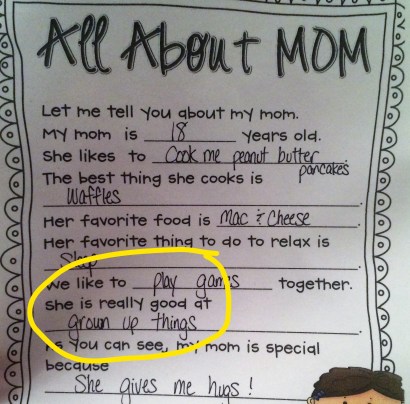
I don’t think that anyone would describe me as playful. I’ve never been whimsical, or theatrical, and only my children think I’m silly. And no one was surprised when the All About Mom page my son brought home for Mother’s Day last Spring basically listed my greatest strength as “adulting.”

img_5082-2_ink_li

But even though my love for To Do lists and productivity is deep and wide, I’ve also spent a surprising amount of my adult life thinking about play. First, as an early childhood and elementary education major, then as a children’s minister, and now also as a parent.

Admittedly, these days this thinking could often be more accurately  described as worrying, particularly about the play habits of my own children. Do my children play enough or too much?  Do they do the right kinds of play—free play, structured play, imaginative play, cooperative play? Do they play outside enough? Do they read enough? Is it okay that my son almost never wants to color?  How much technology-driven play should I allow? Should I be playing with them more or does that take away from their capacity for independent play? Should their play have a purpose? Are they playing right? Is it possible to play wrong?

Play is generally described as engaging in an activity that is 1) voluntary, 2) enjoyable and 3) open-ended and flexible. Play is about the experience, not the ending. If your play can only have one specific outcome it’s not play, it’s a project or a competition.

Play is not a break from the real world. It is how you discover it.  Play is how you try things on, practice various roles and personas to see if they fit, practice the rules and then change them, join in the act of creation, imagine the world as it could be.

As the ever-wise Mr. Rogers explained, “Play is often talked about as if it were a relief from serious learning. But for children play is serious learning. Play is really the work of childhood.”mr-rogers-quote

And research shows that play is not just the work of children, it is the work of all of us. The need for play does not end when we become adults. “We don’t lose the need for novelty and pleasure as we grow up,” says Dr. Scott G. Eberle in the American Journal of Play. “Play brings joy. And it’s vital for problem solving, creativity and relationships.”

I think play is also vital for faith. We must be able to play with our faith.

I know that sounds counter intuitive or irreverent even. For many of us faith is IMPORTANT. Shouldn’t we WORK at faith, not play at it? But it’s a false dichotomy that buys into the lie that work and play are opposites. I believe faith, like play, must also 1) be voluntary, 2) enjoyable, in the sense that it is rooted in joy rather than pain or fear, and 3) it must be open-ended, flexible, and changeable.

In this way faith and play are inextricably linked. This is a problem for a society of adults who have been conditioned to believe that play should only be done if all of your ducks are in a row. (Has anyone seen my ducks?) But if those are the terms, we’re doomed from the start

i-dont-have-my-ducks-in-a-row-i-have-5828704

But play is not frivolous. Educators, researchers, and Mr. Rogers all affirm that play is, and always has been, real, meaningful work. Work that must be born and fostered in childhood, but that needs to continue into a healthy adulthood. Play is the work we do to practice imagination, try on new ideas, and dress up in various roles to see how they fit.

Play allows us to try out our our strengths and our weaknesses, in low-stakes settings. Play is where we learn to dream, to wonder, and to question reality. Play is where we practice telling, hearing, and getting caught up in Stories. Play is where we learn to create and respond with our bodies through music and dance. Play is where we learn to use and grow our imagination.

And for those of us who are Christians, and affirm that Jesus is God revealed to us, then we understand Play to be a part of the very nature of God. If we have in our minds a humorless, Vulcan-esque image of Christ, we didn’t get it from Scripture. Even in the small snippets of Jesus’ life depicted in the Bible, we find that our God has sharp sense of humor, a lively imagination and a penchant for creative storytelling.

We serve a God that enjoys word play and told humorous stories about a person who tried to take a speck out of a friend’s eye while a giant log was sticking out of his own. We serve a God that could look at nobody, a screw up, or a terrorist, and imagine the world-changing person they could become. We serve a God that knew when he needed to rest and when he needed some time alone with nature. We serve a God with a self-deprecating sense of humor that led him to lead a Royal parade on a donkey rather than the traditional horse in order to make a point. We serve a God that created the Blob Fish and the duck-billed platypus.

And if play is part of the very character of God, perhaps as God-seekers we need elevate the role of play in our lives individually in our faith communities.

This means we must MAKE space for play to happen. We are no longer children, who will naturally play given the smallest amount of time. Instead of the adult method of rushing through mundane tasks, children naturally transform ordinary moments into opportunities for exploration, wonder and play. My 4-year-old son cannot walk by a drawer or a cabinet without opening it to see what’s inside. He slithers like a snake down the hallway to retrieve his jacket. He plays with every toy as he puts it away. It. Is. Maddening. And yet it’s inspiring.

So many of us adults have had play conditioned out of us, however. We no longer see the world as full of wonder and possibility, but as a problem to be fixed. So we get from Point A to Point B in straight lines, our minds already thinking about the next task. When we do have little bits of time we choose distraction, not imagination. So it’s precisely because play is no longer as instinctual to us as pulling out our phones that we must purposefully make space for it in our lives. And we need to do it especially when we feel like we don’t want to, when we couldn’t possibly find the time, when there are lots and lots of important things to be done. It is at these times that we need to play the most.

Because if we have lost the ability to play, we have lost the ability to imagine. And if we can no longer imagine, then what are we doing here? What are we doing when we come together in our faith communities? We might be upholding tradition. We might be passing along knowledge or rules. We might be enjoying each other’s company. But we are certainly not on a journey of faith. We are definitely not participating in the Kingdom of God. Because to believe that Love and Grace can change the world is to imagine what such a world would look like, what people transformed by God would look like, and to have the playful, imaginative faith that this could be so.

Kingdom of God, To Do Lists

To Do Lists, Neglected Plants, and the Kingdom of God

In a timely act of kindness, my mother took my kids today for some special time with Grandma and Grandpa, which left me with an unexpected block of time to use however I wanted. Although I contemplated a 5-hour nap, I decided what I wanted most out of my child-free day was to check off a number of those little tasks on my To Do List that had overstayed their welcome by several days, weeks or even months.

You know the kind of thing I’m talking about: those easy-to-put-off tasks like changing the battery in the clock that stopped working who-knows-how-long-ago, putting away the stray Christmas item left behind in the post-Epiphany decoration rapture, or shredding the pile of papers that have been accumulating for the last 6 weeks months.  These were tasks that I knew would only take a few minutes each, but somehow kept getting pushed forward indefinitely to the list for “tomorrow.”

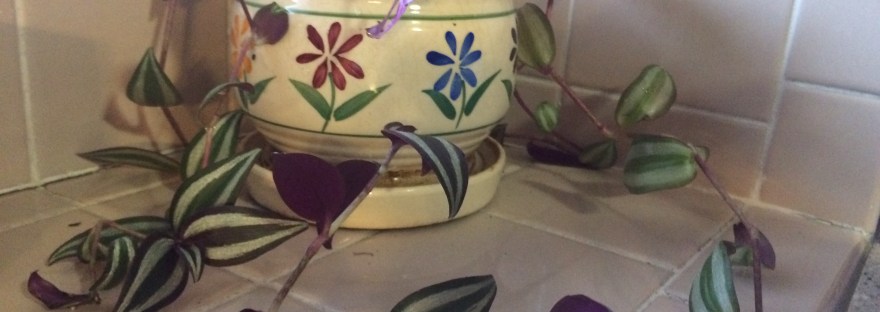
Top on my Just-Get-It-DONE list for today was “re-pot plants,” which sounds a lot less urgent than it actually was. What it should have said was “put the plants IN pots.” As in, these two innocent plants had been living in mason jars of ONLY WATER on my kitchen window sill for the last 3 months. (At least. I lost track.)  Even my preschooler knows that plants need air, sunlight, and soil to survive, and here I was actively withholding one of these three basic needs for no reason, other than the fact that my plants aren’t able to cry out for food like the rest of the humans and animals in this house. Clearly, no one has ever accused me of having a green thumb.

And YET, here they were, these two little plants, using the light and water they had, and their God-given DNA, to keep on keeping-on, every day. Despite my neglect, despite tiny Basil Plant being munched on every day by the cat, despite the the winter chill that was coming through the window, they survived.

I found so much encouragement and hope in that thought today. Plants are resilient. They grow in rocky soil and in no soil. They re-emerge after forest fires and nuclear explosions. Plants are fighters. And so are Humans. Even when the world in cruel and unfair, when society is structured in a way that denies people the basic things they need and the rights they deserve, it is possible (though not inevitable) to survive. We are stronger than we think, more hearty than we imagine.

But I believe we are made for so much more than survival. I believe in a God who wants every person to experience wholeness that comes from re-creation, and redemption born out of love and grace. I believe in a God who calls us to reality based on abundance, not scarcity. A reality where we make choices out of empathy, not fear. An upside down Kingdom where the last are first and the most energy goes toward caring for the “least of these,” not into catering to the rich and powerful.

I believe in a Faith that compels us to use our voices to cry out on behalf of those who are voiceless, who are being neglected, who are vulnerable or overlooked. A faith that calls us not only use our eyes to see the needs around us and our voices to cry out, “Hey, we need some soil over here!” I believe that living into the reality of a grace-filled Kingdom means we must also use our hands to dig into the ground, getting dirt under our nails, and then we use our feet to bring the nutrient-rich soil to the people and places that need it most.

My plants survived my neglect, but when I turned my apathy into empathy it made growth possible. That’s the kind of home I want to live in–a place where ever person (and even plant!) is unburdened by the weight of mere survival, and is then free to grow into who they were created to be. That’s the kind of community and society I want to live in, too. Most importantly, I believe that is exactly the type of Kingdom that God invites us into every day.

Blogging, Enneagram, Vulnerability

Nine Reasons I Should Definitely NOT Start a Blog

One of my New Year’s Resolutions for 2013 was to (re)start a blog. Yes, 2013 as in 4 years ago year. For longer than my toddler has been alive, I’ve been talking myself out of writing a blog for what I think are some pretty good reasons.

  1. I do not have time to blog. I have a job, a never-quite-clean house and a family that consists of a husband, two very busy children, and two cats who all want to eat EVERY day. Who has time for writing?
  2. I have no idea what I am doing. While my more forward-thinking friends were taking an HTML code class in high school, I was taking journalism study hall (a class that was literally made up just for me).  Trying to figure out how to do anything besides add words to a blog makes me sweat.
  3. Sometimes I get excited about new things and then don’t finish them. Rarely. Occasionally. Actually, it was probably just once… a week.
  4. I never want to say the phrase “I didn’t know how much I would need this blog.” There’s a superstitious (or perhaps just pessimistic) part of me that feels like this could just be inviting trouble. Isn’t that just tempting fate to send me something horrible my way so that I’ll have to write about it to process it & be whole? Am I the only one who thinks these things?
  5. No one will read it anyway. Why would they? There are a million blogs out there already. I’m not famous or an expert in anything in particular. The thought of pushing “publish”on a post and then having nobody comment or even read it is depressing. Wouldn’t it be better to just get a notebook and start a diary?
  6. Wait, what if they DO read it? This is possibly even more horrifying. What if I write down my thoughts and musings and people actually READ them? Am I really ready to put myself out there like that?
  7. Because seriously, Internet people are mean. We all know by now that trolls aren’t just creepy 80s toys. They lurk on the Web to say horrible, hateful things to people. Even mostly-civilized people, even people we know and usually like, have a tendency to say unnecessarily harsh and mean things when they can hide behind the shield of the Internet.
  8. People will judge me. Anyone could read this blog–my family, my friends, my acquaintances, possibly even people I’ve never met. Letting other people read my writing is an act of vulnerability. No matter what I say, it is very likely some people who read it will disagree with my thoughts, opinions, faith, or decisions. People who I respect and care about may be disappointed, frustrated or angry with me because of what I write. This is a sobering thought.
  9. Did I mention vulnerability is hard?  I’m admittedly not great at it. I am a Six on the Enneagram and have trust issues. But I absolutely believe Brene Brown when she says that “Vulnerability is the birthplace of love, belonging, joy, courage, empathy, and creativity.” I want these things in my life. Will vulnerability be easier or harder on the Internet? I have no idea. I guess we will find out.